Understanding Winter Premises Liability Laws
When winter weather strikes, the accumulation of snow and ice creates more than just a seasonal inconvenience; it introduces significant safety hazards for pedestrians, residents, and customers alike. Legally, the responsibility for maintaining safe walking surfaces falls under the umbrella of premises liability. This area of law dictates that property owners and managers have a "duty of care" to ensure that their premises are reasonably safe for those who are legally allowed to be there. When an owner fails to address a known hazard, such as a frozen puddle or a snow-covered walkway, and someone is injured as a result, the owner may be held liable for damages.
However, winter slip and fall cases are notoriously complex because the conditions are often changing rapidly. Unlike a spill in a grocery store aisle that remains static until cleaned, snow can continue to fall and temperatures can fluctuate, causing cycles of melting and refreezing (often resulting in "black ice"). To win a case, a victim must prove that the property owner was negligent in their maintenance duties. This generally involves showing that the owner knew or should have known about the ice, had a reasonable amount of time to clear it, and failed to take appropriate action. Navigating these rules requires an understanding of both state-level statutes and local municipal ordinances that govern snow removal timelines.
Affected by a Premises Liability Issue?
Our specialized tool can help you estimate the potential worth of your case based on current laws and precedents.
The "Reasonable Person" Standard in Winter Maintenance
The cornerstone of most premises liability claims is the concept of "reasonableness." Courts do not expect property owners to be magicians or to keep every square inch of their property perfectly dry and ice-free during a blizzard. Instead, the law asks: What would a reasonable property owner have done under similar circumstances? This standard takes into account the severity of the weather, the type of property, and the resources available to the owner.
For example, a reasonable owner of a high-traffic commercial shopping mall is expected to have a much more aggressive snow removal plan than a private homeowner. The mall might be expected to have salt and sand applied before a storm starts and to have plows active throughout the day. Conversely, a homeowner might only be expected to shovel their sidewalk within a few hours after the snow stops falling. Factors that influence the reasonableness of an owner's actions include:
- The duration and intensity of the storm.
- The time of day the ice formed versus when the fall occurred.
- The availability of ice-melt products or professional plowing services.
- The visibility of the hazard to a pedestrian.
- Whether the owner followed their own internal safety protocols.
If you have been injured on a property that seemed neglected during a freeze, you can use a premises liability calculator to see how these factors might translate into a settlement value.
Natural vs. Unnatural Accumulation of Ice and Snow
One of the most important—and often confusing—legal distinctions in winter injury cases is the difference between natural and unnatural accumulation. Historically, many states followed the "Massachusetts Rule" (or the Natural Accumulation Rule), which stated that property owners were not liable for injuries caused by snow and ice that accumulated naturally. The logic was that since winter weather is an act of nature, owners shouldn't be penalized for conditions they didn't create.
However, many jurisdictions have shifted toward the "Connecticut Rule," which requires owners to exercise reasonable care regardless of how the snow got there. Even in states that still observe the natural accumulation rule, an owner becomes liable if they create an "unnatural" hazard. Examples of unnatural accumulation include:
- Meltwater dripping from a defective or clogged gutter onto a sidewalk and refreezing into a patch of ice.
- Snow being shoveled into a pile that later melts across a walkway and freezes.
- A parking lot designed with poor drainage that allows large puddles to collect and turn into ice sheets.
- Applying salt in a way that creates a slushy mess which later hardens into an uneven, jagged surface.
Proving that your fall was caused by an unnatural accumulation can significantly strengthen your claim, as it demonstrates that the property owner’s specific actions (or lack of maintenance) created a hazard that wouldn't have existed otherwise.
Property Owner Notice: Actual vs. Constructive
A property owner cannot be held liable for a hazard they didn't know existed. In legal terms, this is referred to as "notice." To successfully pursue a claim, the injured party must prove that the owner had either actual or constructive notice of the dangerous ice or snow. Actual notice is straightforward: the owner saw the ice, or someone told them about it. For instance, if a tenant emailed a landlord about a frozen walkway at 8:00 AM and the landlord did nothing by 2:00 PM, actual notice has been established.
Constructive notice is more common and involves proving that the hazard existed for a long enough period that the owner should have discovered it during a routine inspection. In winter cases, this often involves looking at weather reports. If a freezing rain event ended at 10:00 PM and a fall occurred at 10:00 AM the next day, the owner had 12 hours to notice the ice and apply salt. A jury would likely find that 12 hours is sufficient time for a property manager to have "constructive knowledge" of the danger. Evidence like security camera footage, maintenance logs, and testimony from other residents can be vital in establishing how long the ice was present before the accident.
Local Ordinances and the Duty to Shovel
While state law provides the broad framework for liability, local municipal ordinances often set the specific rules for snow removal. Many cities and towns have laws requiring property owners to clear public sidewalks adjacent to their property within a certain timeframe. Common requirements include:
- Time Limits: For example, New York City requires owners to clear snow within 4 hours after the snow stops (if it stops between 7 AM and 4:59 PM) or by 11 AM the next day if it stops overnight.
- Path Width: Many ordinances require a path of at least 36 to 48 inches wide to allow for wheelchair and stroller access.
- Prohibitions: Most cities forbid shoveling snow into the street, as this creates a hazard for drivers.
If an owner violates a local ordinance, it can be used as evidence of negligence in a civil lawsuit. This concept is known as "negligence per se." If the law says you must shovel within six hours and you didn't, the court may view that as an automatic breach of the duty of care. You can find more information on how municipal safety rules impact cases in this guide on building code violations. According to the Occupational Safety and Health Administration (OSHA), walking on snow and ice is one of the leading causes of workplace injuries, and similar standards for clearing pathways apply to commercial employers.
Liability at Commercial Properties: Stores and Parking Lots
Commercial property owners—such as grocery stores, big-box retailers, and office complexes—owe the highest duty of care to their visitors, who are legally classified as "invitees." Because these businesses profit from the public entering their property, they are expected to be proactive in their winter maintenance. This duty extends beyond the front door to include the entire parking lot and all entryways.
Parking lot falls are particularly common and often high-value claims because they involve large areas that are difficult to salt perfectly. Many businesses hire third-party snow removal contractors to handle these tasks. If a fall occurs, the injured party may end up suing both the business owner and the snow removal company. Legal questions often arise regarding the contract between the two: Did the contractor fail to show up, or did the business owner fail to call them? Determining who is at fault requires a deep dive into service logs and weather data. If you were injured at a commercial venue, it is helpful to look at how hotel or resort liability works, as the standards for guest safety are very similar.
Residential Liability: Landlords and Tenants
In residential settings, the question of who is responsible for shoveling often depends on the type of dwelling and the terms of the lease. In most multi-unit apartment buildings, the landlord is responsible for clearing common areas, including sidewalks, stairs, and parking areas. They cannot generally "contract away" this duty to tenants in a way that absolves them of liability to the public.
In single-family home rentals, the lease may specify that the tenant is responsible for snow removal. However, if the tenant fails to shovel and a third party (like a mail carrier) slips and falls, the property owner may still be named in a lawsuit. The mail carrier might argue that the owner failed to ensure the property was being maintained according to local laws. For families dealing with injuries at residential properties, identifying the correct insured party is the first step in recovering compensation. The National Safety Council (NSC) notes that falls are the leading cause of nonfatal injuries in the United States, highlighting the importance of residential safety.
Comparative Negligence: Were You at Fault?
One of the most common defenses used by insurance companies in winter slip and fall cases is "comparative negligence." The adjuster will argue that the injured person was partially responsible for their own fall. They might ask questions such as:
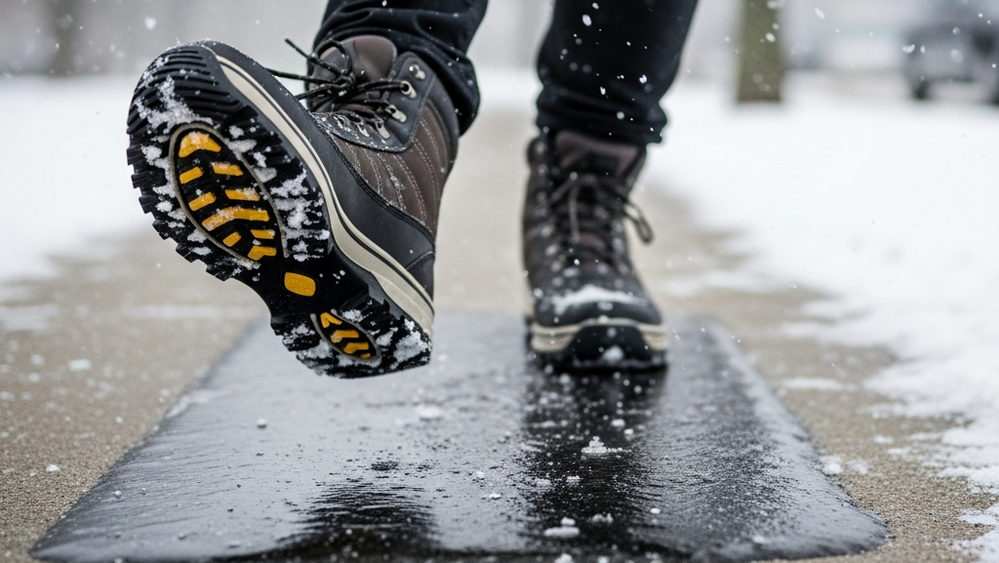
- Were you wearing appropriate footwear for the weather (e.g., boots vs. high heels)?
- Were you distracted by your phone while walking?
- Did you ignore a yellow "Wet Floor" sign or a visible pile of snow?
- Were you running or walking faster than the conditions allowed?
Most states follow a comparative negligence model where your final settlement is reduced by your percentage of fault. For example, if your total damages are $100,000 but a jury finds you were 20% at fault for wearing smooth-soled shoes on an icy day, you would receive $80,000. Some states follow a "modified" version where you cannot recover anything if you are more than 50% or 51% at fault. Understanding how your actions impact your claim is vital. More information on this can be found in our guide on comparative negligence.
Essential Evidence to Collect After a Fall on Ice
Because ice can melt within minutes of the sun coming out or a salt truck arriving, the window to collect evidence in a winter slip and fall case is extremely small. If you are physically able, taking the following steps immediately after a fall can make or break your case:
- Photos and Video: Capture the ice from multiple angles. Use an object (like a coin or a pen) to show the thickness of the ice if possible. Take wide shots to show the lack of salt or sand across the entire area.
- Identify the Source: Look up. Is there a leaky pipe or a gutter pouring water onto the spot where you fell? This helps prove unnatural accumulation.
- Witness Information: Get the names and phone numbers of anyone who saw you fall or who can testify about the condition of the property earlier in the day.
- Weather Records: Save a screenshot of the local weather forecast and temperature at the time of the fall. This establishes whether the owner should have been aware of the freezing conditions.
- Keep Your Shoes: Do not throw away or continue to wear the shoes you were wearing during the fall. They are physical evidence of your attempt to walk safely.
Documentation is the foundation of a successful claim. The Cornell Law School Legal Information Institute emphasizes that the plaintiff bears the burden of proof in negligence cases, making this early evidence collection essential.
The Role of Medical Treatment in Case Valuation
In the eyes of an insurance company, if you didn't seek medical treatment immediately, you weren't truly injured. After a slip and fall on ice, the body is often in shock, and the full extent of injuries—especially soft tissue damage, concussions, or spinal misalignments—may not be apparent for 24 to 48 hours. Seeking immediate care at an ER or Urgent Care ensures that your injuries are documented and linked directly to the fall.
Your "case value" is heavily dependent on your medical records. The total cost of your medical bills acts as a "baseline" that insurers use to calculate pain and suffering. If you have a "gap in treatment" (waiting weeks to see a doctor), the insurance company will argue that you were injured elsewhere. Following your doctor's treatment plan until you reach Maximum Medical Improvement (MMI) is critical. To understand how medical expenses drive settlement numbers, you can explore the motor vehicle accident calculator, as the methods for calculating medical damages are very similar across personal injury types.
Common Injuries in Winter Slip and Fall Accidents
Falls on ice are often more violent than falls on dry land because the lack of friction causes the feet to fly out from under the body, leading to a direct impact with the hard ground. Common injuries include:
- Traumatic Brain Injuries (TBIs): Striking the back of the head on ice can cause concussions or more severe brain trauma.
- Wrist and Arm Fractures: Naturally, people reach out to break their fall, leading to Colles' fractures or shattered elbows.
- Hip and Pelvic Fractures: This is especially common among older adults and often requires surgery and long-term rehabilitation.
- Spinal Cord Injuries: A hard landing on the tailbone can compress vertebrae or cause herniated discs.
According to the Centers for Disease Control and Prevention (CDC), one out of every five falls causes a serious injury such as a broken bone or a head injury. These injuries often result in high "special damages" (economic losses like lost wages and medical bills), which in turn increase the "general damages" (non-economic losses like pain and suffering).
Calculating Your Settlement: What Is Your Claim Worth?
There is no single "average" settlement for a slip and fall on ice because every case depends on the severity of the injury and the clarity of the liability. However, lawyers and insurance adjusters generally use a formula to arrive at a starting point for negotiations. This formula typically involves:
- Economic Damages: The sum of all medical bills (past and future), lost wages, and out-of-pocket expenses.
- Non-Economic Damages: A "multiplier" (usually between 1.5 and 5) is applied to the economic damages to account for pain, suffering, and loss of quality of life. A broken wrist might receive a 2x multiplier, while a permanent spinal injury might receive a 5x multiplier.
For example, if a victim has $20,000 in medical bills and $5,000 in lost wages, their economic total is $25,000. With a 3x multiplier for a painful surgery and recovery, the total claim value would be estimated at $75,000. Factors that can increase this value include permanent scarring, the inability to return to the same line of work, and clear evidence of gross negligence by the property owner. To get a personalized estimate, visit our premises liability calculator.
Statutes of Limitations: Why You Can't Wait
Every state has a deadline for filing a personal injury lawsuit, known as the statute of limitations. For most premises liability cases, this window is between two and four years. While this may seem like a long time, winter cases require extensive investigation that should happen while memories are fresh and evidence is available.
Furthermore, if your fall occurred on government property (such as a sidewalk in front of a post office or a city-owned park), the rules are much stricter. Many states require you to file a "Notice of Claim" within as little as 30 to 90 days after the accident. Failing to meet these deadlines will result in your case being permanently dismissed, regardless of how severe your injuries are. Consulting with a legal professional early ensures that these critical deadlines are tracked and met.
Conclusion: Seeking Justice After a Winter Injury
Winter weather is an inevitable part of life in many regions, but the injuries caused by negligent property maintenance are not. If a property owner failed to clear snow or address a dangerous ice patch, they should be held accountable for the medical bills and suffering they have caused. Proving a slip and fall case on ice requires a combination of timely evidence, an understanding of local ordinances, and a clear demonstration of the owner's negligence.
If you or a loved one has been injured this winter, don't guess at the value of your claim. Use our tools to understand your rights and the potential compensation available to you. Knowledge is power when dealing with insurance companies that want to minimize your recovery. To see what your claim might be worth based on your specific injuries and the circumstances of your fall, use our premises liability calculator for a free evaluation today.
Disclaimer: This blog post is for informational purposes only and does not constitute legal advice. For specific legal guidance regarding your situation, please consult with a qualified attorney.