Understanding the Complexity of Pedestrian-Vehicle Accidents
When a pedestrian is hit by a car, the physical, emotional, and financial consequences are almost always catastrophic for the individual on foot. Unlike occupants of a vehicle, pedestrians have no protective shell, airbags, or seatbelts to mitigate the impact of thousands of pounds of steel. Because of this inherent vulnerability, many people assume that the driver is always legally at fault. However, the legal reality of personal injury law is far more nuanced. Liability is not automatic; it is based on the concept of negligence and the specific traffic laws governing the location of the collision.
To successfully navigate a legal claim, it is essential to understand how fault is determined, the role of state laws, and what victims can do to protect their rights and maximize their potential compensation. This guide provides a comprehensive look at how fault is determined, the role of state laws, and what victims can do to protect their rights and maximize their potential compensation. If you have been injured, using a motor vehicle accident calculator can be a vital first step in understanding the potential value of your claim.
Affected by a Legal Tips Issue?
Our specialized tool can help you estimate the potential worth of your case based on current laws and precedents.
The Duty of Care: A Shared Responsibility
In the eyes of the law, every road user—whether driving a car, riding a motorcycle, or walking—owes a "duty of care" to others. This means acting in a way that a reasonable person would to avoid causing harm. For drivers, this duty is particularly high because they are operating a dangerous machine. According to the NHTSA pedestrian safety guidelines, drivers must always remain alert and prepared for the presence of pedestrians, even when those pedestrians are not following the rules perfectly.
Pedestrians, however, also have a duty to exercise reasonable care for their own safety. They cannot simply step into traffic and expect cars to stop instantly if doing so is physically impossible. When a collision occurs, the legal process involves examining whether the driver or the pedestrian breached their respective duty of care. This investigation looks at factors such as speed, visibility, weather conditions, and whether traffic signals were obeyed. Understanding these legal steps to take after an accident is critical for preserving evidence that proves the other party's negligence.
Marked vs. Unmarked Crosswalks: Legal Definitions
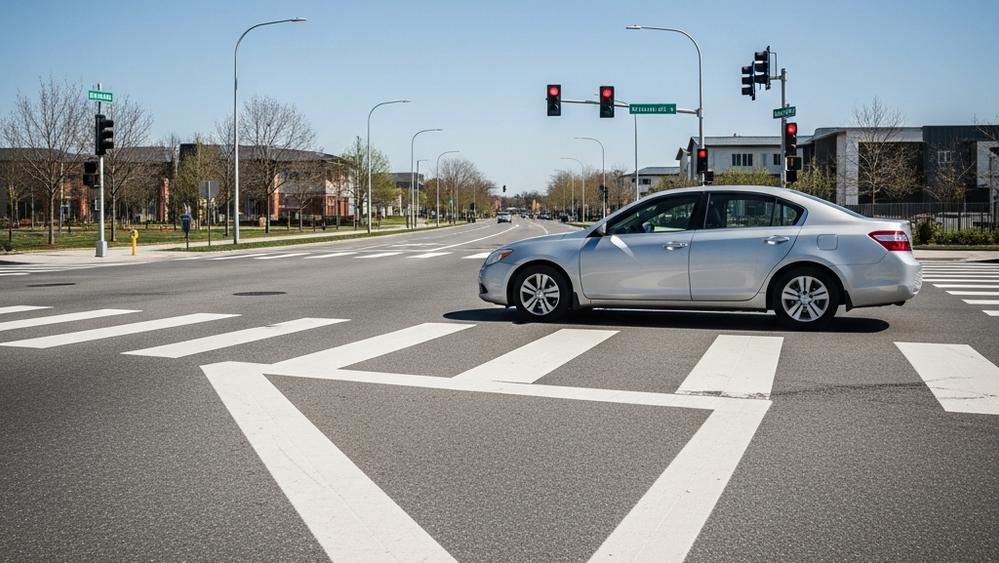
One of the most common misconceptions in pedestrian law is that crosswalks only exist where there are painted white lines on the road. In reality, most states recognize both "marked" and "unmarked" crosswalks. A marked crosswalk is the familiar set of painted lines at an intersection or mid-block. An unmarked crosswalk, however, typically exists at any intersection where sidewalks on opposite sides of the street meet at right angles, regardless of whether lines are painted.
In both marked and unmarked crosswalks, pedestrians generally have the right of way. Drivers are legally required to yield to a pedestrian who has entered the crosswalk on their side of the road. If a driver hits a pedestrian in a crosswalk, the driver is almost always considered at fault, as they have violated a clear traffic law. However, even in a crosswalk, a pedestrian cannot suddenly leave a curb and walk or run into the path of a vehicle which is so close that it is impossible for the driver to yield.
The Legal Reality of Jaywalking
"Jaywalking" is a colloquial term rather than a formal legal one in many jurisdictions. It generally refers to a pedestrian crossing the street outside of a designated crosswalk or against a traffic signal. While jaywalking is technically a traffic violation in most cities, it does not automatically mean a pedestrian loses their right to sue for damages if they are hit.
In many modern legal frameworks, the focus is shifting away from strict jaywalking enforcement toward a more balanced view of road safety. For example, some states have recently passed laws that prevent police from citing pedestrians for crossing outside of crosswalks unless there is an immediate danger of a collision. From a personal injury perspective, the question isn't just "were they jaywalking?" but rather "did the driver have a reasonable opportunity to avoid the collision despite the pedestrian's location?" Drivers are expected to maintain a lookout; if a pedestrian is visible in the road for several seconds before the impact, the driver may still be held partially or fully liable for failing to brake or swerve.
How Fault Is Determined: The Role of Evidence
Determining fault in a pedestrian accident requires a meticulous reconstruction of the events leading up to the impact. Insurance adjusters and personal injury attorneys look at several key pieces of evidence:
- Police Reports: The initial assessment by responding officers, including any citations issued at the scene.
- Surveillance and Dashcam Footage: Video evidence from nearby businesses or the vehicle involved can be the "smoking gun" in proving fault.
- Witness Statements: Neutral third-party observers who saw the light colors or the pedestrian's movements.
- Physical Evidence: Skid marks, the location of debris, and the point of impact on the vehicle provide clues about speed and braking distance.
- Electronic Data: Modern vehicles often have "black boxes" (Event Data Recorders) that capture speed and braking data in the seconds before a crash.
According to the Cornell Law School's definition of negligence, the plaintiff must prove that the driver's conduct fell below the standard of care expected of a reasonable person under similar circumstances. If a driver was distracted by a phone, speeding, or failing to use headlights at night, these factors weigh heavily in favor of the pedestrian.
The Impact of Comparative Negligence Laws
Most states follow a system of "comparative negligence," which allows for fault to be shared between the driver and the pedestrian. This is the most critical concept for jaywalking cases. If a jury determines that a pedestrian was 30% at fault for crossing mid-block, but the driver was 70% at fault for speeding, the pedestrian can still recover 70% of their total damages.
There are two primary types of comparative negligence:
- Pure Comparative Negligence: A victim can recover damages even if they are 99% at fault, though their award is reduced by their percentage of fault. (e.g., California, Florida, New York).
- Modified Comparative Negligence: A victim can only recover damages if their fault is below a certain threshold, usually 50% or 51%. If they are found more responsible than the driver, they receive nothing. (e.g., Texas, Illinois, Ohio).
Because of these rules, insurance companies will work hard to shift as much blame as possible onto the pedestrian. They may argue the pedestrian was wearing dark clothing, was looking at their phone, or was intoxicated. Combatting these arguments requires a strong legal strategy and comprehensive evidence gathering.
Common Driver Defenses in Pedestrian Accidents
Drivers and their insurance providers often utilize specific legal defenses to avoid paying large settlements. One common defense is the "Sudden Emergency Doctrine." This argues that the pedestrian appeared so suddenly and unexpectedly that the driver had no time to react, meaning their failure to stop was not negligent but a physical impossibility.
Another defense is the "Last Clear Chance" doctrine, which is sometimes used by pedestrians against drivers. This doctrine posits that even if the pedestrian was negligent (jaywalking), the driver had the "last clear chance" to avoid the accident but failed to do so. For example, if a pedestrian is standing in the middle of a well-lit road and a driver has plenty of room to move over but is distracted and hits them anyway, the driver may still be held fully liable.
Dealing with Rideshare and Commercial Vehicles
If you are hit by a vehicle being driven for a company like Uber or Lyft, or a commercial delivery truck, the liability landscape changes. These drivers often carry much higher insurance limits than private citizens, but proving liability in rideshare accidents involves determining the driver's "app status" at the time of the crash.
Commercial vehicles, such as those owned by major retailers or shipping companies, are subject to federal and state regulations. If a commercial driver hits a pedestrian while fatigued or after violating hours-of-service rules, the parent company can be held vicariously liable for the damages. These cases are often high-value but involve aggressive defense teams, making professional legal guidance essential.
What Happens When the Driver Is Uninsured?
In a perfect world, every driver would carry sufficient insurance to cover the medical bills and suffering of a pedestrian they hit. Unfortunately, many drivers are underinsured or carry no insurance at all. If you are hit by such a driver, or if you are the victim of a hit-and-run, you may feel like you have no recourse.
However, many pedestrians are surprised to learn that their own auto insurance policy might cover them. Uninsured Motorist (UM) coverage typically follows the policyholder, not just the car. This means if you are walking and get hit by an uninsured vehicle, your own UM policy should provide benefits. Navigating accidents with uninsured drivers requires a thorough review of your own insurance declarations page to identify available coverage.
Calculating the Economic and Non-Economic Damages
Pedestrian accidents often result in high-value claims because the injuries are typically severe. Damages are categorized into two types:
- Economic Damages: These are objective, calculable losses. They include hospital bills, physical therapy costs, lost wages, and the cost of future medical care or home modifications needed due to permanent disability.
- Non-Economic Damages: These are subjective losses that impact the victim's quality of life. This includes pain and suffering, emotional distress, loss of enjoyment of life, and loss of consortium (the impact on the victim's relationship with their spouse).
In cases of extreme negligence, such as a drunk driver or a hit-and-run, a court may also award "punitive damages." These are not intended to compensate the victim but rather to punish the driver and deter others from similar behavior. Because of the severity of these injuries, calculating an accurate case value is complex. Victims should consider using a professional motor vehicle accident calculator to ensure they are not accepting a lowball settlement offer from an insurance company.
Special Populations: Children and the Elderly
Courts and insurance companies view accidents involving children and the elderly with extra scrutiny. Children are legally held to a different standard of care than adults. The law recognizes that a child may not understand the dangers of traffic, leading to the "Attractive Nuisance" or "Infant Plaintiff" doctrines in some contexts. Drivers are expected to exercise "extreme caution" when driving near schools, playgrounds, or residential neighborhoods where children are likely to be present.
Similarly, elderly pedestrians may move more slowly and require more time to cross a street. A driver who starts moving as soon as a light turns green without checking if an elderly pedestrian has finished crossing can be found negligent. The CDC pedestrian safety data highlights that older adults and children are at a significantly higher risk for fatal pedestrian collisions, necessitating higher standards of vigilance from motorists.
The Importance of Medical Documentation
Following a pedestrian accident, the most critical step after ensuring safety is seeking immediate medical attention—even if you feel "fine." Adrenaline can mask the symptoms of internal bleeding, traumatic brain injuries (TBI), or spinal damage. From a legal perspective, a gap in treatment is an invitation for the insurance company to argue that your injuries were either not caused by the accident or are not as severe as you claim.
Your medical records serve as the foundation of your claim. They provide a direct link between the collision and your physical condition. Ensure that your doctors document the cause of the injury and any long-term limitations you may face. If you are unable to return to work, medical testimony will be required to prove your loss of earning capacity.
Moving Forward with a Pedestrian Injury Claim
Recovering from being hit by a car is a long and difficult journey. Between the physical recovery and the mounting medical bills, the legal process can feel overwhelming. However, understanding the difference between crosswalk rights and jaywalking realities is the first step in asserting your rights. Remember that jaywalking does not give a driver a license to hit you; if they could have avoided the crash, they should be held accountable.
If you or a loved one has been injured, do not navigate the complex world of insurance negotiations alone. Use our motor vehicle accident calculator today to get an instant estimate of what your claim could be worth and take the first step toward securing the justice and compensation you deserve.
Disclaimer: This blog post is for informational purposes only and does not constitute legal advice. For specific legal guidance regarding your situation, please consult with a qualified attorney.